
Sex Offender Checks in Clinton County
The Illinois State Police Sex Offender Registry is the primary public channel. ISP says it updates daily. Use the county filter for Clinton County, a name search when identity is known, or the geographic map for an address-centered view. No separate Clinton County registry database or alert app was verified.
The ISP search page shown below provides the statewide interface.
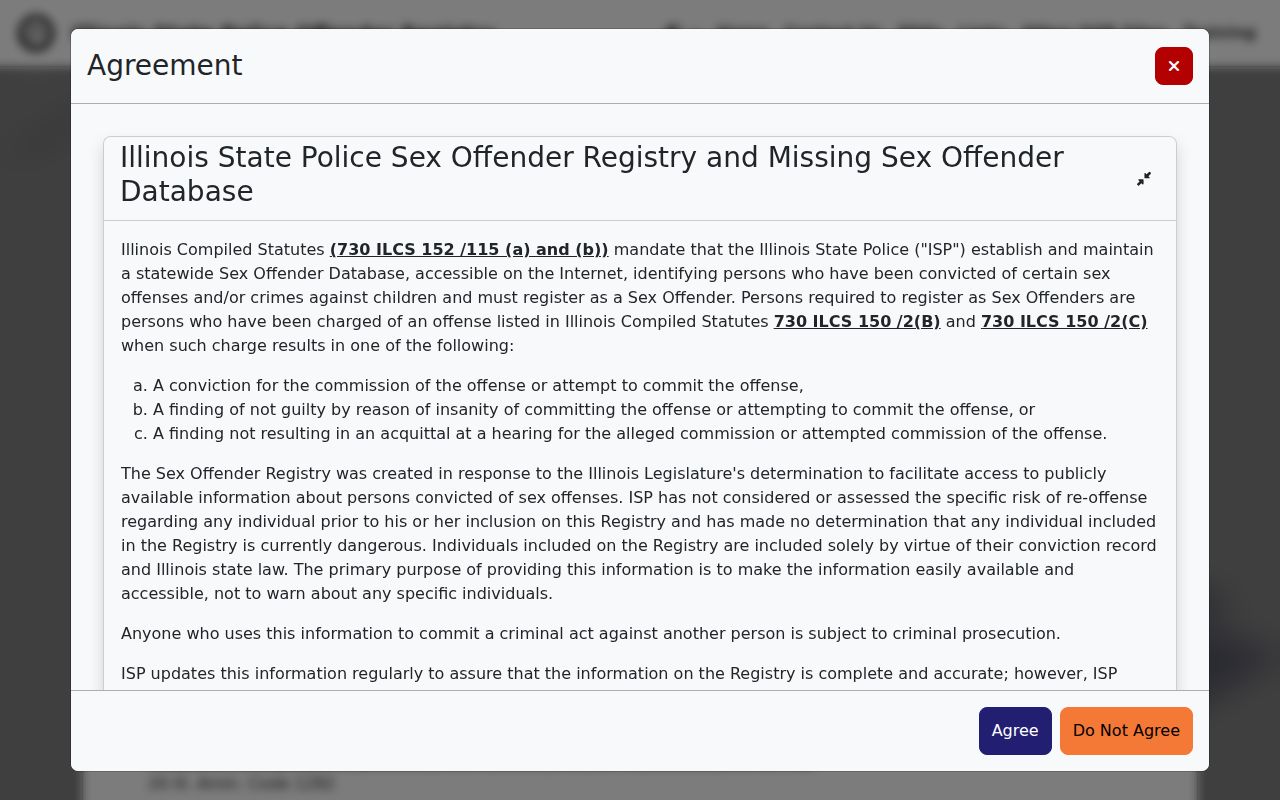
Read each result at the state source, then note the “as of” date before acting on it.
Daily ISP Registry Updates
Daily updates help, but an address or status can still change between registration events. A no-result search may reflect spelling, an alias, a different date of birth, incarceration, out-of-state status, or a record outside the public disclosure rules. Start broad, then narrow.
Municipal residents register in person with their city police department. People in unincorporated Clinton County register with the sheriff at 810 Franklin Street, Carlyle. Call 618-594-4555 to confirm current appointment practice. The registering agency is also the first local contact for a suspected error or noncompliance.
How to Search the Illinois State Police Sex Offender Registry
The interface supports both identity and place searches. Combining a first and last name with a date of birth can reduce false matches. For place-based awareness, enter a city, ZIP code, county, or address map point. Illinois law provides mapping within five miles, but distance does not assign equal risk to everyone shown.
- Open the official ISP registry and read its conditions of use.
- Search by name, or filter by city, ZIP code, Clinton County, status, or type.
- Compare aliases, date of birth, location, and photo before matching a person.
- Open Details and read the as-of date, compliance, agency, classification, offense, and duration.
| Field Label | Type | Required | Notes |
|---|---|---|---|
| First and Last Name | Text | No | Begin with both, then test known aliases. |
| Date of Birth | Date/text | No | Useful to distinguish similar names. |
| City or ZIP | Text | No | Location filter for public listings. |
| County/Incarcerated/Out of State | Dropdown | No | Select Clinton or another displayed category. |
| Status, Homeless, Offender Type | Dropdown/checkbox | No | Refines the public result set. |
| Address or Map Point | Map | No | Supports statutory five-mile mapping. |
Inside a Registry Profile
Open Details and check the profile's as-of date before reading further. The inspected interface displayed classification, compliance, identity, aliases, physical descriptors, address, registering agency, registration dates, duration, offense descriptions, conviction county, and dated photo history. It did not display a risk score.
| Name & Aliases | Primary and alternate names and birth dates used for identity matching. |
|---|---|
| Photo & Description | Dated photo history plus height, weight, sex, and race. |
| Registered Address | Public address tied to the stated update date. |
| Offense | Description, victim and offender ages, and conviction county when displayed. |
| Classification | Illinois statutory category and linked explanation. |
| Registration Status | Compliance, agency, original and recent registration dates, and duration. |
Multiple Photos and Aliases
Several dated images on one ISP profile show a photo history, not several people. Alias names and alias dates of birth explain why a single spelling can miss a result. Compare the whole profile and avoid identifying someone from appearance alone.
The ISP profile field layout was reviewed only to document labels.
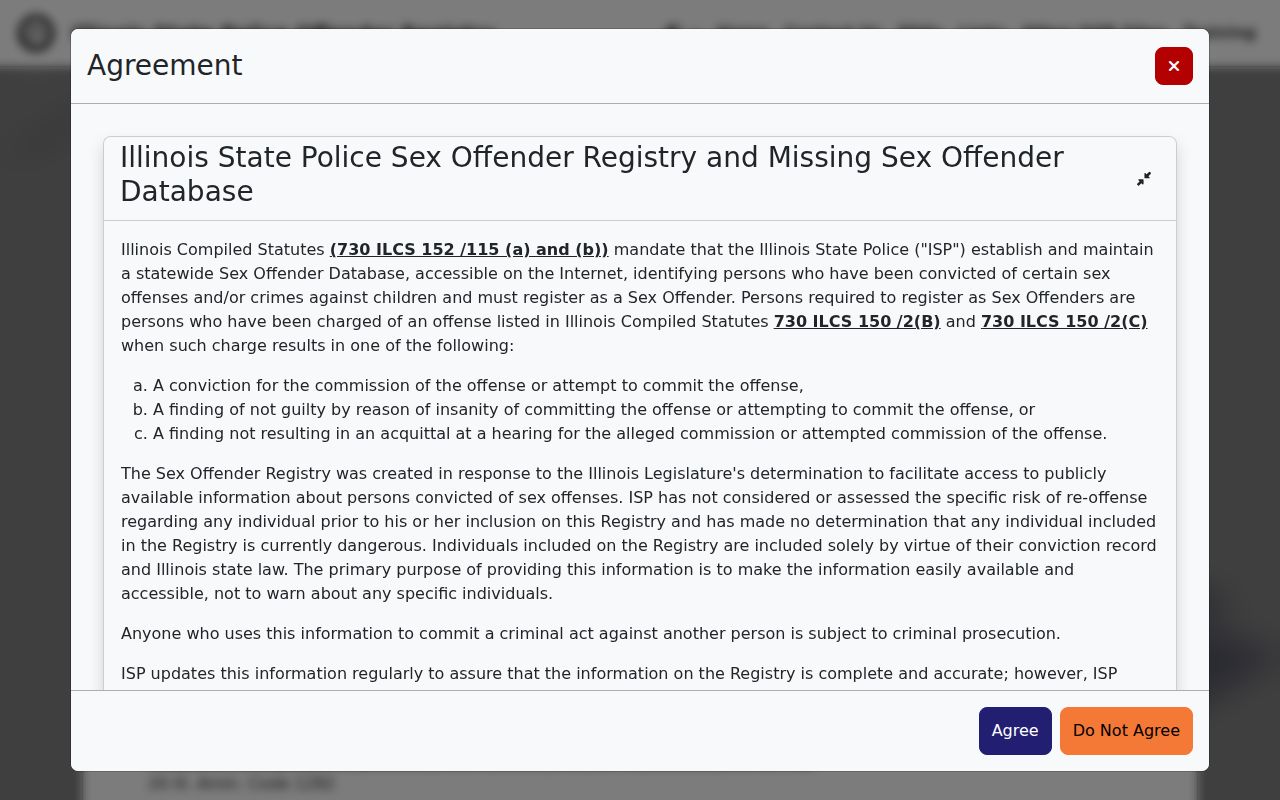
The image is useful for learning the interface, never for spotlighting a private individual.
Illinois Registration Levels and Requirements
Illinois does not publicly organize every registrant under the federal Tier I, II, and III labels. Its statutes use categories and events that set the duty's length. Registration occurs in person within three days of sentencing or release, with positive identification and proof of residence. The initial and annual fee is $100, subject to an indigence waiver.
| Level / Tier | Duration | Verification Frequency |
|---|---|---|
| Sexually dangerous or sexually violent person | Natural life | Follow current statutory schedule |
| Sexual predator or repeat registrant | Natural life | Follow current statutory schedule |
| Other registrant, no confinement | 10 years after conviction or adjudication | Follow current statutory schedule |
| Other registrant, confined | 10 years after parole, discharge, or release | Follow current statutory schedule |
| Unrelated later confinement | Remaining time is tolled | Resume as statute directs |
| Noncompliance | May add 10 years | Agency verifies after violation |
Ten Years, Life, and Tolling
Duration does not always run in a straight line. Related reconfinement can start a new ten-year period after final release, while unrelated confinement pauses the remaining period. Noncompliance may extend the duty ten years from the first registration after the violation. Read 730 ILCS 150/7 for the controlling duration rules.
The official statute source shown below supports those distinctions.
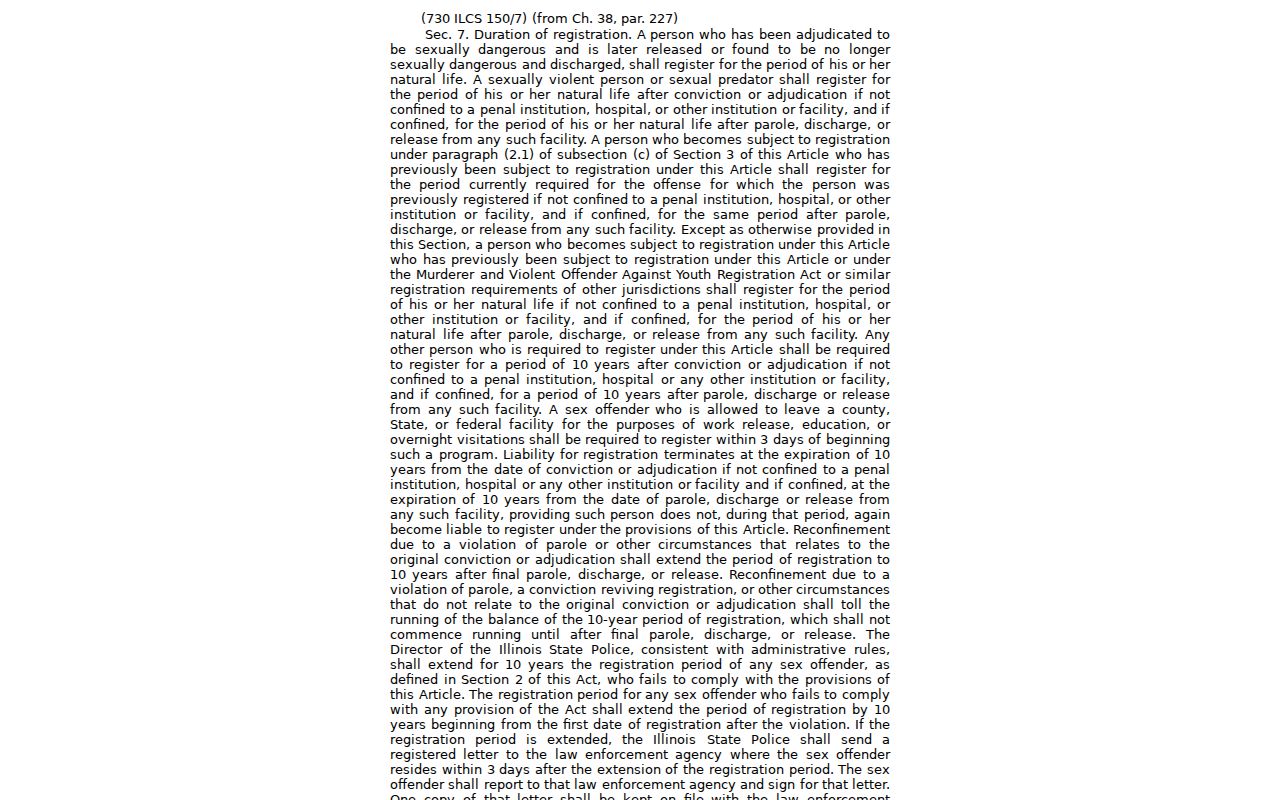
The correct bucket depends on the legal classification and custody history, not a guess from the offense label.
Clinton Registration Office Routes
People living inside a municipality register with that city police department. Those living in unincorporated Clinton County use the sheriff. Copies of registration forms should be requested from the current registering agency, while conviction documents come from the clerk or State's Attorney in the county of conviction.
730 ILCS 150/3 covers in-person registration, identification, residence proof, timing, and fees.
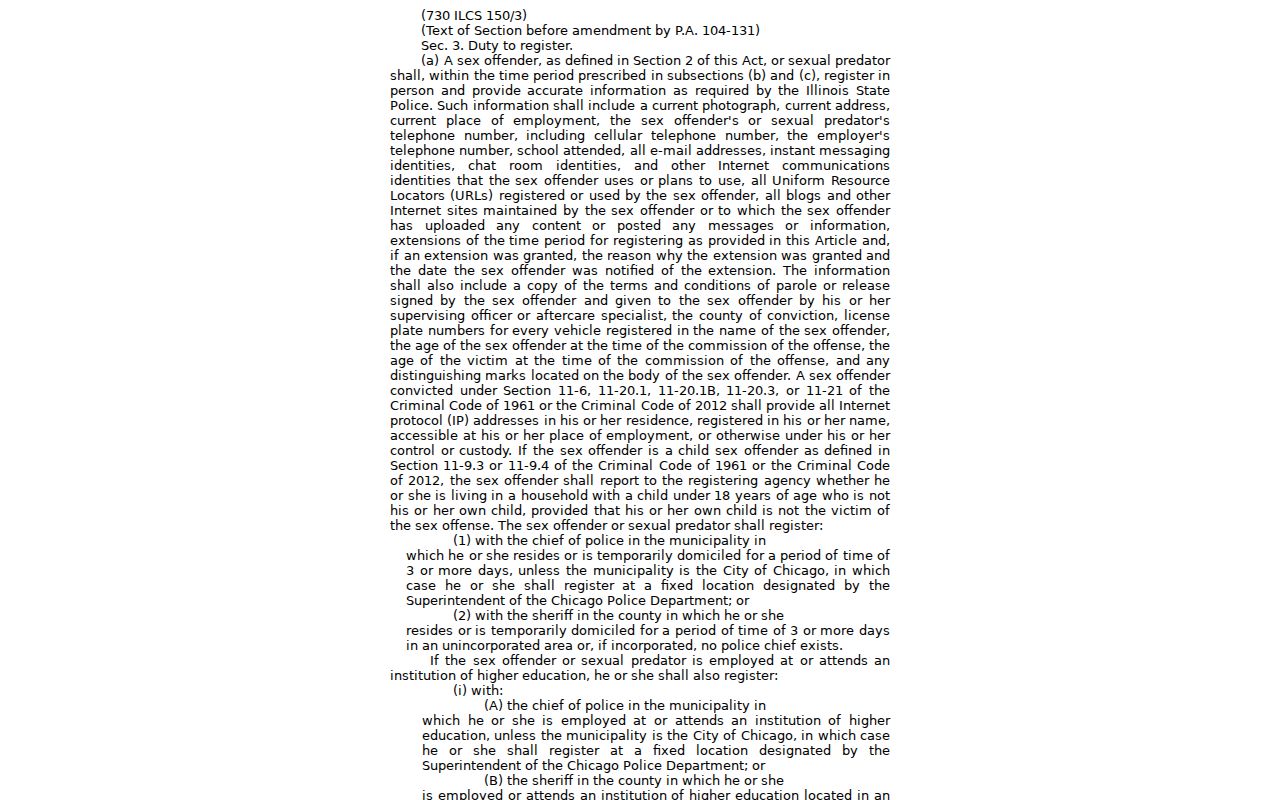
Call the Clinton County Sheriff before visiting because the research did not verify appointment hours.
NSOPW Across County Lines
The National Sex Offender Public Website combines official participating jurisdictions for cross-state name and address searches. It is valuable near county or state lines, but each result should be opened and verified at the source registry.
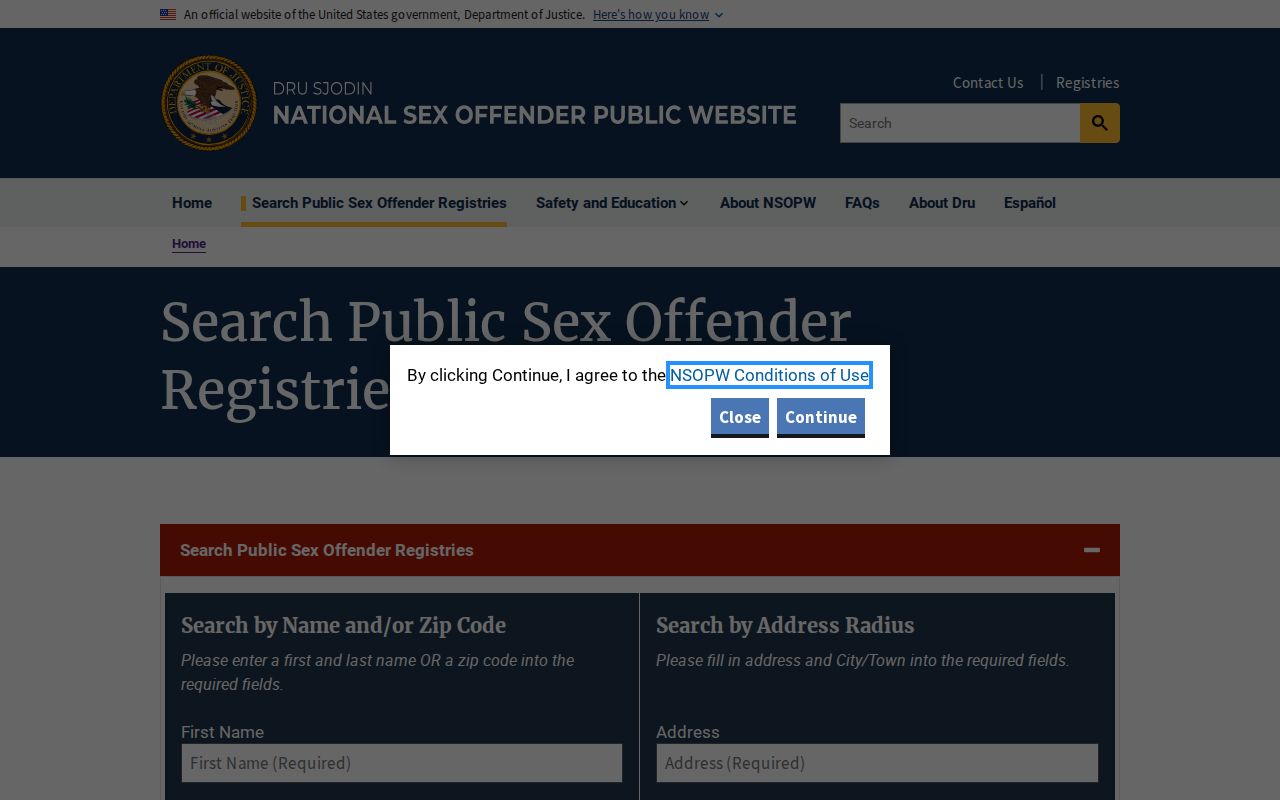
NSOPW expands geographic coverage without turning a registry profile into a full criminal-history report.
Five-Mile Clinton County Map
Illinois's geographic search accepts an address or a map point and displays public registry records within the statutory map coverage. Under 730 ILCS 152/115, that mapping function extends within five miles. A yellow marker can open profile details. The radius is a search boundary, not an assessment that all listed people present the same risk.
Before planning around a result, open the profile and check its date, status, address, and registering agency. Someone marked incarcerated or out of state may not have a conventional local street address. A homeless flag also changes how location data should be read. The safest interpretation stays close to the fields displayed.
No verified ISP or Clinton County email proximity-alert signup was found in the reviewed official sources. Do not invent one or substitute a commercial alert product. Repeat the official map search when circumstances require an updated view. For a local data concern, contact the police department shown as the registering agency or the Clinton County Sheriff for an unincorporated address.
The public profile can link outward to IDOC, UCIA, or a circuit clerk because each source answers a separate question. The registry states registration facts. A conviction file explains the judgment. An IDOC locator addresses state custody. UCIA provides Illinois conviction information under its own rules. None should be treated as a replacement for the others.
When an address falls near a county line, search beyond the Clinton filter as well. NSOPW can provide the cross-jurisdiction layer, followed by verification at the originating state registry. This matters because daily ISP updates do not make the Illinois-only filter a national search.
Correcting Clinton County Registry Data
A public profile may lack the context found in the conviction file or registration form. Start with the field that appears wrong. Record the profile's as-of date, registering agency, and exact entry. Do not publish or circulate personal details while trying to resolve the question.
Send a suspected registration error to the police department or sheriff named on the profile. ISP also provides ISP.SOR.Unit@illinois.gov. Ask the current registering agency for any releasable registration-form copy. The conviction county's circuit clerk or State's Attorney holds court documents, while the involved police agency holds the original incident report. Each custodian may redact information protected by law.
Suspected noncompliance follows the same local route. Provide facts to law enforcement and avoid direct contact with the listed person. Failure to register or knowingly providing false information can bring serious felony consequences under Illinois law, but a member of the public should report the concern rather than decide guilt.
A profile omission should be described narrowly. The inspected ISP layout did not show vehicles, employers, schools, eye or hair color, scars, tattoos, statute number, or conviction date. That interface observation does not prove Illinois law forbids an agency from holding or disclosing each field elsewhere.
For a Clinton County court record, use the circuit clerk. For a state-custody record, follow IDOC. For an Illinois conviction inquiry, use UCIA. The registry remains the proper source for current public registration facts and should not be stretched into a full criminal-history product.
Community Notification and Lawful Use
Registry information supports family safety, neighborhood awareness, and informed contact with law enforcement. It does not establish current conduct, a universal risk level, or every past offense. Juvenile disclosure is narrower under the Community Notification Law and should not be assumed to match adult public access.
Use registry information lawfully: Illinois law forbids using public registry information to harass, threaten, or intimidate a registrant or household. Never engage in vigilantism.
Report suspected noncompliance to the residence or registering agency, or email ISP.SOR.Unit@illinois.gov. Report a suspected data error through the same agency so the custodian can check the registration form. Do not contact or confront the listed person.